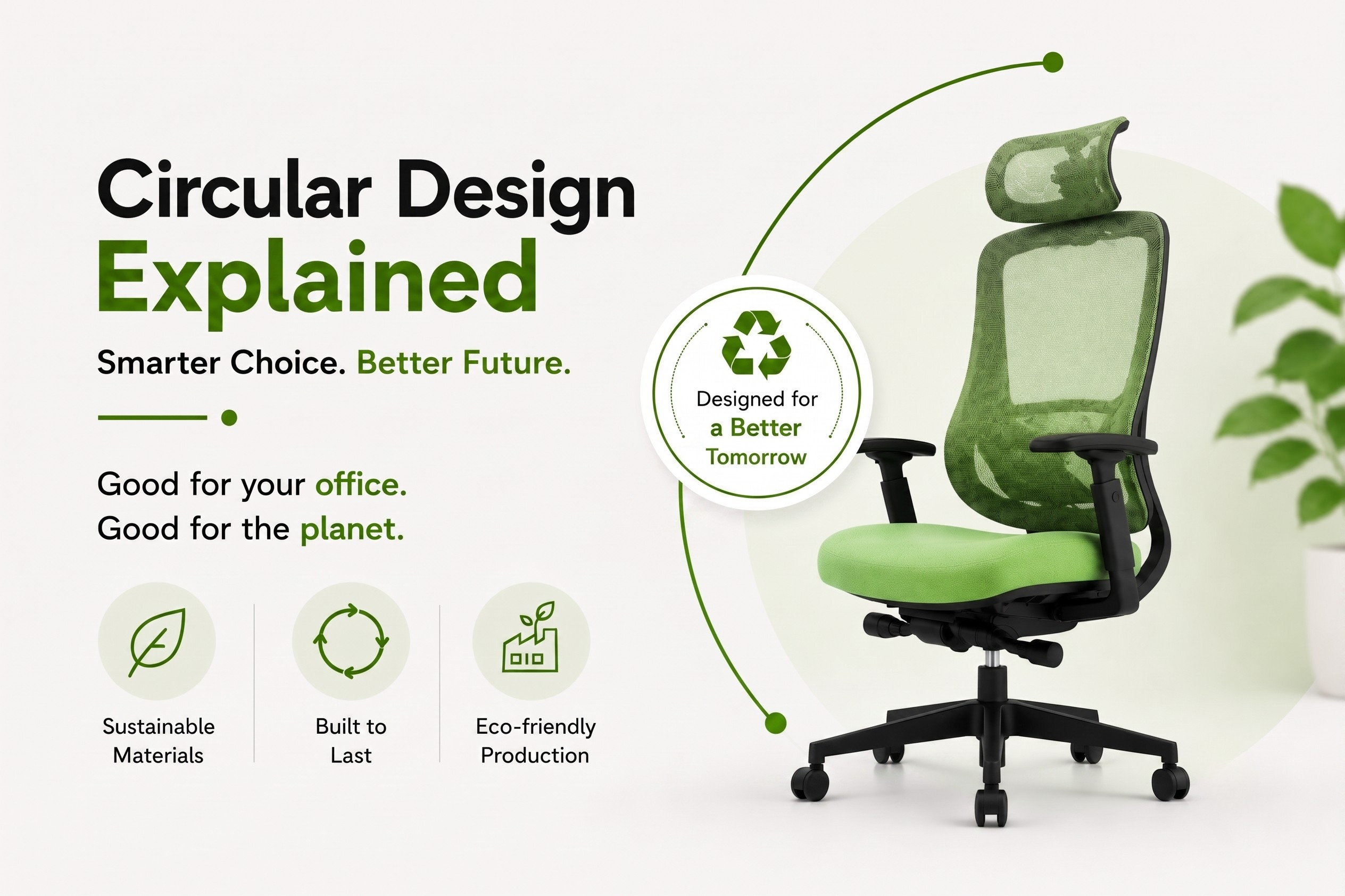
Sustainability claims abound across the office furniture industry. However, not all certifications have equal credentials. One certification currently gaining notoriety is the Circular Design Certificate. The name may be somewhat technical, but its intent is very clear: it is simply used to indicate whether the design of any given product was intended to allow for longevity, reuse, repair and responsible disposition once it has reached its end of life.
If you are considering purchasing a new office chair and would like to know what this certification means, it may be beneficial to do a little research on this certification. Knowing what the Circular Design Certificate is will assist you in making more informed decisions for purchasing. This is particularly important if you are purchasing a product based on sustainability criteria.
What Is Circular Design and Why Does It Matter?
Most office furniture follows a linear model: manufactured, sold, used until it wears out, and then disposed of. Circular design works differently. A product built to circular principles is designed from the start with its full lifespan and end of life in mind. The materials are selected because they can be recovered. The components are built so they can be serviced or replaced individually, rather than requiring the whole chair to be discarded when one part fails. And the intended lifespan is planned and warranted, not just assumed.
For office chairs specifically, this matters because they are high-volume, resource-intensive products. When they are not built for longevity or recovery, the environmental and cost consequences compound quickly across a fleet. According to The Furniture Shows’ 2026 ESG report, circularity is now moving from a sustainability consideration to an active procurement expectation, with buyers asking for certification to support claims rather than accepting them on trust.
What Is a Circular Design Certificate?
The dc Circular Design Certificate is an independent certification issued by Design Conformity. It is not a self-declared claim by the manufacturer. It verifies that a product has been assessed against circular design criteria by a third party, and that its carbon impact has been independently measured and reported to ISO 14067 and GHG Protocol standards.
What the certification covers:
- Independent Scope 3 carbon reporting to ISO 14067 and the GHG Protocol
- A product designed for a planned first life and a planned second life, not just until it breaks
- Materials structured for recovery at end of life, not disposal
- A verifiable certificate reference number that procurement teams and ESG auditors can check independently
- Applicable across furniture types, so specifiers can use one framework across multiple product categories
A Circular Design Certificate is not just a marketing badge. It represents a structured assessment of how a product is made, maintained, and eventually returned to the material cycle.
Why Does This Matter When You Are Buying an Office Chair?
Most organisations replace office chairs every seven to ten years. Across a larger office estate, that adds up to a significant volume of furniture going through disposal. If those chairs cannot be easily recycled, the environmental impact accumulates rapidly.
Choosing chairs with a Circular Design Certificate helps you to:
- Reduce your organisation’s contribution to landfill waste
- Align your procurement choices with corporate sustainability targets
- Support supplier relationships that reflect your environmental values
- Demonstrate due diligence to stakeholders, clients, and reporting frameworks
- Potentially qualify for procurement credits under green building or sustainability schemes
There is also a commercial argument. Chairs that are designed for durability and repairability tend to have longer service lives. That can translate into lower replacement costs over time, which is relevant to any budget-conscious facilities or procurement manager.
Additional Read:
Benefits of Circular Certified Office Chairs
Key takeaways
- Circular design means the product was built with its full lifespan and end of life planned in, not just its first use
- The dc Circular Design Certificate is issued independently by Design Conformity and includes a verifiable reference number
- It provides ISO 14067-aligned Scope 3 carbon data at product level, useful for ESG reporting and Scope 3 accounting
- For procurement, it represents a lower total cost of ownership because the product is warranted and built for a longer, defined lifespan
- It differentiates a substantiated sustainability claim from an unverified one in a market where both are common
Frequently asked questions
What is the Circular Design Certificate?
The dc Circular Design Certificate is an independent certification from Design Conformity. It verifies that a product has been designed in line with circular economy principles and that its carbon footprint has been measured and reported to ISO 14067 and GHG Protocol standards. It carries a verifiable reference number that procurement teams and ESG auditors can check.
How is this different from general sustainability claims?
A general sustainability claim is made by the manufacturer and is not independently verified. The CDC is issued by a third party following assessment against defined criteria. The certificate number can be verified independently, which makes it a documentable credential rather than a marketing statement.
What does first life and second life mean for an office chair?
The two different phases of use comprise the first phase (the initial use phase) which is approximately 5 years in length with a good quality ergonomic chair. The second (or “renewed”) use phase will take place after refurbishing or redeployment; thus the total life to be expected from the furniture will be 10 years in total. This is incorporated into the design and warranty, rather than applied after the fact.
Why does ISO 14067 alignment matter?
ISO 14067 is the international standard for calculating and communicating the carbon footprint of a product. When a chair’s carbon impact is reported to this standard, the methodology is recognised and the data can be used directly in Scope 3 carbon accounting rather than requiring the buyer to estimate it separately.
Does the JH Chairs CDC cover the full range?
The dc Circular Design Certificate (reference dc 102091) covers the JH Chairs range as designed and produced, aligned with ISO 14067 and designed for a 5-year first life plus 5-year second life. Full certification documentation is available on request through jhchairs.co.uk for procurement, tender, or ESG reporting purposes.
Making the Right Choice for Your Workplace
When you are investing in office seating, the decision is rarely just about how the chair feels on day one. It is about how it performs over years of use, how it reflects your organisation’s values, and what happens to it when it reaches the end of its working life.
The Circular Design Certificate gives you a meaningful, independently verified way to evaluate whether a chair has been built with all of that in mind.
At JH Chairs, our chairs carry the Circular Design Certification, reflecting our commitment to sustainability alongside ergonomic performance. Whether you are outfitting a single desk or an entire office floor, our range is designed to support your team through the working day and to meet the environmental standards that modern procurement increasingly demands.
Explore our full range of certified ergonomic office chairs, designed for all-day comfort and built with sustainability at their core.