
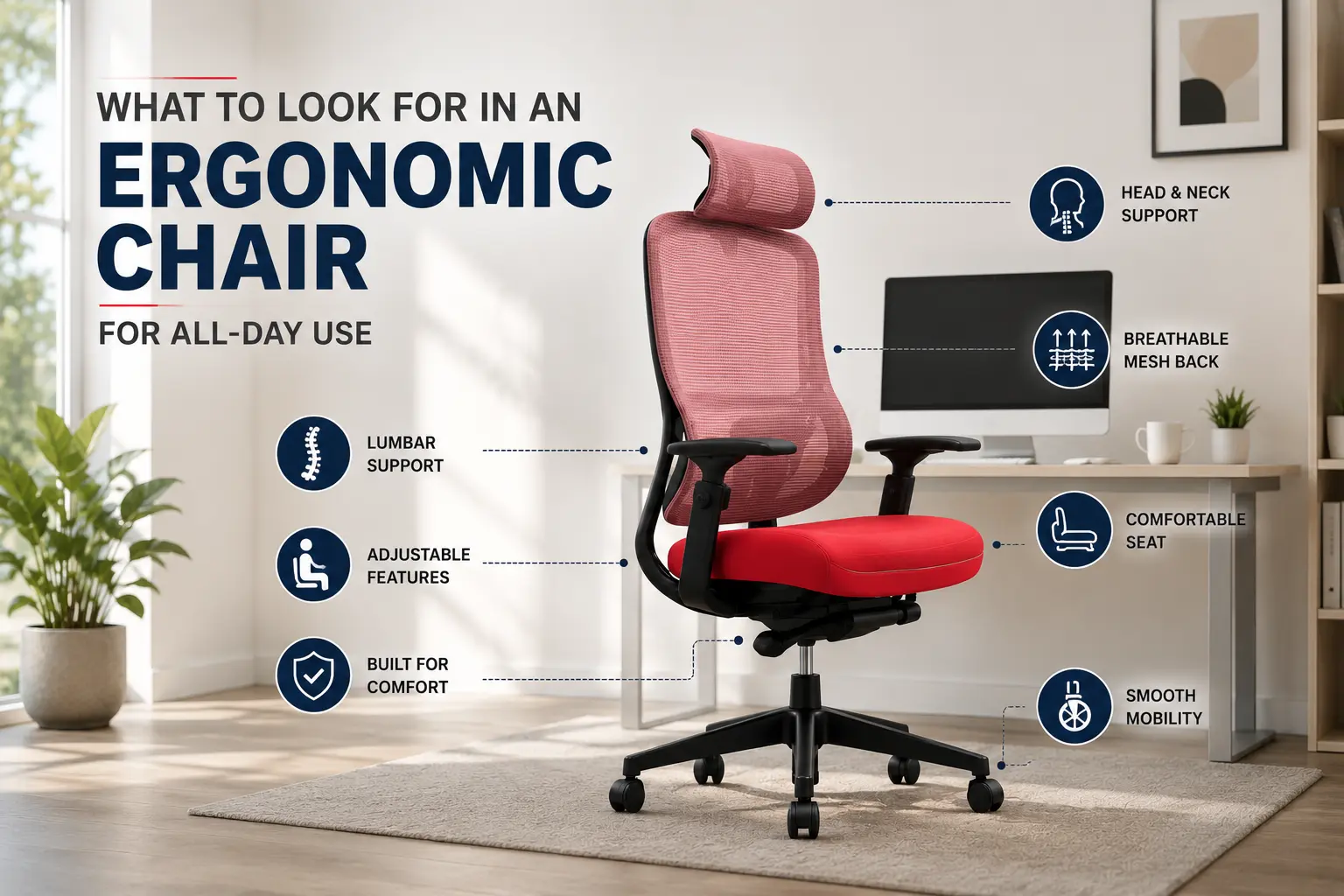
Why Most Office Chairs Are Not Built for Long Hours
Most chairs are designed to be sat in. Fewer are designed to be sat in for eight hours straight, five days a week, without the person doing the sitting ending the day feeling stiffer than when they started. The difference between those two things is not marketing language or price point. It is a specific set of features that determine how well a chair supports the body during sustained use.
Research shows that the average desk worker now spends the majority of their waking hours seated. The global ergonomic chair market has grown considerably as businesses shift focus from office aesthetics to actual employee wellbeing, driven largely by the recognition that a chair used for most of the working day needs to be built for that purpose. This guide covers what to look for, what questions to ask, and how to tell the difference between a chair that is genuinely designed for all-day use and one that merely claims to be.
What Makes a Chair Suitable for All-Day Use?
The phrase all-day use is common in chair marketing but rarely defined. In practical terms, a chair designed for all-day use needs to do three things that a standard task chair does not: it needs to support a neutral spine position passively, it needs to accommodate natural postural movement rather than locking the user in one position, and it needs to do both of those things consistently across a range of body sizes and proportions.
The issue with many chairs on the market is that they are designed to look ergonomic in a showroom or photograph. They have a prominent lumbar pad, a high backrest, and multiple levers underneath the seat. What the photograph does not show is whether the lumbar pad adjusts to the individual user, whether the seat depth suits different leg lengths, or whether the back tilt resistance is calibrated to anything other than a population average. Those details are where the practical difference lives.
According to Secretlab’s ergonomic research team, a chair can genuinely be considered ergonomic for all-day use only if it can be used for extended daily hours with minimal discomfort and supports postural variation rather than a single fixed position. Sitting rigidly upright for a full working day is not a healthy or sustainable posture. The chair needs to support movement, not eliminate it.
The Features That Matter for Long Hours
Lumbar support with depth and height adjustment
Lumbar support is the feature most buyers mention when choosing a chair, and also the one most commonly oversimplified. A fixed lumbar pad positioned at a set height on the backrest does not provide meaningful support for a user whose lower back sits above or below that point. Adjustable lumbar support that moves both vertically and toward the spine adapts to the individual rather than requiring the individual to adapt to the chair.
For all-day use, the lumbar support should also maintain contact when you shift or recline. A support that is fixed to the backrest frame moves away from the lower back every time you lean back. A floating or independently mounted lumbar system stays in contact through the recline range, which makes a significant difference over the course of a long working day. A peer-reviewed study on PubMed found that proper lumbar support combined with seat pan positioning produced the most neutral spinal and pelvic posture of all configurations tested, but only when the support was actively in contact with the lower back.
Seat depth adjustment
This is one of the most underrated features on any ergonomic chair and one of the most important for all-day comfort. If the seat pan is too long for your leg length, you will slide forward to relieve pressure behind the knees. Doing so means you lose contact with the backrest and lumbar support. If you stay fully back in the seat, the edge presses uncomfortably into the legs. A seat depth slide solves this by allowing the effective length of the seat pan to be adjusted to your proportions, so you can sit fully back without compromise.
Back tilt with tension control
Staying in one fixed posture for hours is more demanding on the body than shifting position regularly. A proper back tilt with tension control allows you to move between a forward-facing working position and a gentle recline, with the resistance calibrated to your body weight so the chair responds proportionally rather than fighting you. This postural variability is what reduces fatigue accumulation over the course of a long day, not any single ideal sitting angle.
Seat height range
The seat height adjustment sets the foundation for everything else. If your feet cannot rest flat on the floor with knees at roughly a right angle at any setting within the chair’s range, the pelvic position is compromised and lumbar alignment follows. Check the minimum and maximum height range against your actual measurements before purchasing. It is the most skipped step and one of the most consequential.
Adjustable armrests
For all-day use, armrests that adjust in height only are a limited solution. The shoulders and neck carry load throughout the day when the arms are not properly supported. Armrests that adjust in depth, width, and pivot allow the forearms to rest naturally regardless of desk height or task, which reduces the accumulated tension in the upper back and neck that most desk workers feel by late afternoon.
Mesh vs Foam: Which Seat Material Is Better?
Seat material becomes more relevant the longer you sit. For occasional or short-duration use, the difference between mesh and foam is marginal. Across a full working day, it is noticeable.
Mesh seating
A breathable mesh back and seat allows air to circulate, which reduces heat and moisture build-up over long periods. This makes a practical difference in comfort during afternoon hours, particularly in warmer environments or in spaces with limited ventilation. Mesh also conforms to the body without applying the concentrated pressure points that a firm foam seat can produce over many hours. The trade-off is that mesh quality varies considerably. A low-quality mesh deforms under sustained load and loses its supportive tension over time.
Layered or moulded foam
A well-engineered layered foam seat, particularly one using a high-density base layer with a softer top layer, provides consistent pressure distribution and retains its shape better than single-layer foam over years of daily use. The risk with foam is heat retention during long sessions and the tendency for lower-grade foam to compress permanently over time, reducing the support the seat was initially providing without the change being immediately obvious.
The practical answer
For most all-day users, a mesh back combined with a structured seat cushion provides the best balance of breathability and pressure distribution. What matters more than material alone is the quality and construction of whichever system the chair uses. A well-built layered foam seat outperforms a cheap mesh seat for long-term support, and a well-tensioned mesh back outperforms a standard foam backrest for all-day breathability.
All-Day Use Checklist: What to Verify Before You Buy
Use this table when comparing any chair described as suitable for all-day or extended use. The first five rows cover the features with the most direct impact on comfort and support over long hours.
| Feature | What It Does | What to Check on Any Chair |
| Adjustable lumbar support | Maintains the lower back curve without muscular effort | Does it adjust in both height and depth? Both axes are needed. |
| Seat depth slide | Ensures the seat fits your leg length so lumbar contact is maintained | Can the seat pan be shortened or extended to suit your proportions? |
| Back tilt with tension control | Allows natural movement and reduces static load on the spine | Does recline resistance adjust to your body weight? |
| Seat height gas-lift | Sets the foundation for correct knee angle and pelvic position | Does the range cover your actual height at both ends? |
| 3D or 4D armrests | Reduces load on the neck and shoulders over long working hours | Do they adjust in height, depth, width, and pivot? |
| Seat material | Affects breathability and pressure distribution over many hours | Is it mesh, moulded foam, or a layered system? How does it handle heat? |
| BS 5459 or UKAC-5459 certification | Confirms independent testing for continuous daily use | Is it in the specification sheet, or just implied by the label? |
Source: HSE: Working Safely with Display Screen Equipment
Key Takeaways
- A chair for all-day use needs to support a neutral spine passively and accommodate natural movement, not lock the user into one posture
- Adjustable lumbar support with both vertical and depth control is the most important single feature. A fixed pad is not a substitute.
- Seat depth adjustment determines whether lumbar support can actually do its job. Without it, users with shorter or longer legs will inevitably lose backrest contact.
- Back tilt with tension control reduces static load accumulation over long hours. Postural variation throughout the day matters more than any single ideal sitting angle.
- Mesh backs offer better breathability for long sessions. Seat material quality matters more than the type, as both mesh and foam vary considerably in performance across price points.
- More expensive chairs do not automatically outperform mid-range ones. Specification, certification, and warranty are the meaningful differentiators.
- A well-specified chair set up incorrectly will still cause discomfort. Setup matters as much as specification.
Frequently Asked Questions
How many hours can you comfortably sit in an ergonomic chair?
A properly specified ergonomic chair is designed for a full working day of continuous use. That said, no chair eliminates the need for regular movement. Health guidance from the HSE and occupational health professionals recommends taking short breaks from sitting every 30 to 45 minutes regardless of chair quality. The chair reduces the physical cost of sitting. It does not make unlimited sitting advisable.
Is a mesh chair better than a foam chair for long hours?
Mesh backs generally offer better breathability, which is a practical advantage during long working sessions in warmer environments. For the seat itself, a well-constructed layered foam or honeycomb seat tends to provide more consistent pressure distribution over many hours than a thin mesh seat. The best outcome for all-day use is typically a breathable mesh back combined with a quality structured seat, which balances airflow against support.
What lumbar support features should you look for in an all-day chair?
Look for lumbar support that adjusts independently of the backrest both vertically and in depth. Vertical adjustment allows it to reach your lower back height. Depth adjustment ensures it makes contact with your lumbar curve rather than sitting behind it. Ideally, the support should also be mounted independently of the backrest frame so it stays in contact when you recline, rather than moving away from the spine as the backrest tilts.
What chair features reduce fatigue during long workdays?
The features that most directly reduce fatigue are back tilt with tension control (allowing postural movement throughout the day), seat depth adjustment (preventing pressure behind the knees), adjustable armrests in multiple axes (reducing load on the neck and shoulders), and quality seat construction that distributes body weight evenly. Fatigue in long-duration sitting is largely the result of static load on specific muscle groups. Any feature that allows the load to shift or reduces it at a particular point helps.
Do expensive ergonomic chairs make a difference for all-day use?
To a point. The most meaningful indicators of value for all-day use are independent certification (BS 5459 or UKAC-5459), warranty length (10 years reflects genuine build confidence), and the presence of seat depth adjustment, independent lumbar control, and multi-axis armrests in the specification. A mid-range chair with these features will outperform an expensive chair that lacks them. Price matters less than specification when the use case is sustained daily sitting.
Conclusion
Choosing an ergonomic chair for all-day use is straightforward once you focus on specification rather than appearance. The chair needs adjustable lumbar support that reaches your lower back, a seat depth suited to your leg length, a tilt mechanism that allows natural movement, and materials and construction that hold up across sustained daily use. When those features are present and the chair is independently certified and properly set up, it does the job it is supposed to do. If you are looking for a chair built around these requirements, explore the JH Chairs range for fully specified ergonomic task chairs and the Everything Chair, all available from UK stock with a warranty and next-day dispatch across the UK and Ireland.