
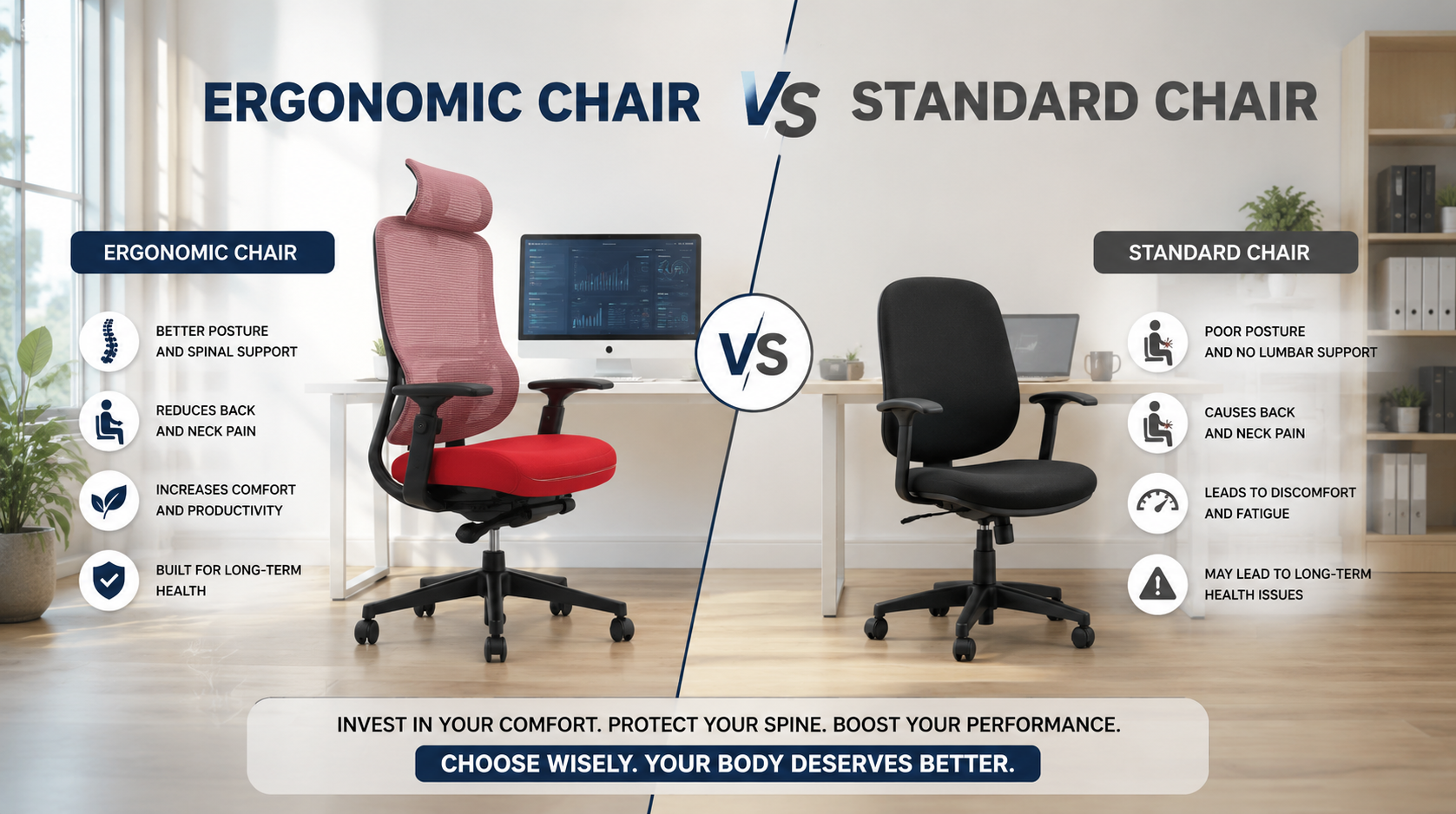
Most people have sat in both. The standard chair — fixed, basic, built for broad usability at a low price. The ergonomic chair — adjustable, engineered around the body, designed specifically for long periods at a desk. The question most buyers reach is whether the difference in cost is actually matched by a difference in how the chair performs across a working day.
The answer depends largely on how the chair is going to be used. But research consistently shows that the majority of UK office workers, particularly those working from home, are sitting in seating that was never designed for sustained daily use. The consequences build gradually and are easy to dismiss until they become a persistent problem. A 2026 ergonomic assessment of home office setups found that workers using non-ergonomic seating reported significantly higher rates of discomfort over six-month periods compared to those in properly specified chairs.
This guide breaks down what actually separates the two types, where the practical difference is felt day to day, and what to look for when making the decision.
Why Standard Chairs Become Uncomfortable Over Time
A standard office chair is built around basic functionality. A seat, a backrest, a gas-lift for height adjustment, and castors. Most offer a simple tilt lock or a fixed backrest angle. Lumbar support, where it is listed at all, tends to be a pad moulded into the backrest at a fixed point that cannot be repositioned for the individual.
These chairs are designed to cover a wide range of buyers at a price point that works for volume. They are not built around a specific body size, a specific working posture, or a specific number of hours per day. For a meeting room chair used a couple of times a day, that is a reasonable fit.
For a primary desk chair used across a full working day, the limitations start to have a real effect on how the person feels by mid-afternoon.
Research published in Scientific Reports in 2025 found that musculoskeletal disorders are highly prevalent among office workers and that the chair used during prolonged desk work is a primary contributing factor when it does not match the user’s body or the hours of use involved.
What Makes an Ergonomic Chair Different?
The word ergonomic is used loosely across the furniture industry, so it is worth being specific about what a properly ergonomic chair actually does that a standard one does not.
Designed Around Your Body
The defining characteristic of a properly ergonomic chair is a meaningful adjustment range that covers different body sizes and proportions. Seat height, seat depth, lumbar position, backrest tilt, and armrest positioning all need to accommodate the actual person sitting in the chair. The majority of office furniture buyers now cite lumbar support as their primary purchase criterion, above aesthetics or price, according to 2026 industry data. That shift in buying behaviour reflects a lesson that a great number of workers have already learnt the uncomfortable way.
Source: Wifitalents: Ergonomic Office Furniture Industry Statistics 2026
Supports Better Posture Naturally
A standard chair asks the user to maintain their own posture through muscular effort. Over an hour that is manageable. Over six to eight hours repeated daily, it accumulates as fatigue in the lower back, neck, and shoulders that most desk workers treat as an unavoidable part of office life. An ergonomic chair is shaped and adjusted to hold a neutral spinal position passively, so the surrounding muscles can relax rather than brace throughout the day.
Built for Long Daily Use
A standard chair is designed for occasional or light use. A properly specified ergonomic task chair is engineered and independently tested for continuous use across a full working day. In the UK, BS 5459 or UKAC-5459 certification confirms this testing at a declared weight capacity. It is not a standard that basic chairs carry, and it is the appropriate benchmark to look for on any chair used as a primary desk seat.
Source: HSE: Working Safely with Display Screen Equipment
Quick Comparison: Ergonomic vs Standard Chairs
Here is how the two compare on the specifications that determine comfort and fit across a working day.
| Feature | Standard Chair | Ergonomic Chair |
| Lumbar support | Fixed or absent | Adjustable in height and depth; independent on specialist models |
| Seat height | Fixed or basic gas-lift with limited range | Gas-lift with a wider range to suit different body heights |
| Seat depth | Fixed | Adjustable slide on properly specified models |
| Backrest adjustability | Fixed angle, limited or no tilt | Adjustable tilt with tension control across a defined recline range |
| Armrests | Fixed height, fixed width | 3D or 4D adjustment covering height, depth, width, and pivot |
| Weight certification | Typically uncertified or limited rating | BS 5459 or UKAC-5459 certified models tested for continuous daily use |
| Intended use duration | Light or occasional use | Designed for sustained use across a full working day |
| Warranty | Typically 1 to 2 years | Up to 10 years on quality UK-stocked specialist chairs |
Source: Workhappy UK: DSE Chair Assessment Guide
When a Standard Chair Is the Right Choice
A standard chair is not the wrong answer in every context. Where the use case does not involve sustained sitting, the ergonomic specification is not necessary and the cost difference is not justified.
- Meeting rooms and breakout areas: Sessions rarely run for more than a couple of hours. A clean, comfortable standard chair is appropriate here and makes practical sense at the scale these spaces require.
- Reception and waiting seating: Visitors and short-stay users do not need a fully adjustable workstation chair. A well-designed standard chair suits this environment well.
- Occasional home use: A spare desk used for short periods a few times a week does not require the same specification as a primary work seat used daily.
The decision point is how long a person sits in that specific chair each day. Once it becomes the primary seat for a full working day, the design and adjustability of the chair start to have a direct and cumulative effect on how that person feels.
When an Ergonomic Chair Is the Right Decision
If any of the following apply, an ergonomic task chair is more appropriate — and more cost-effective when the full picture of comfort, durability, and replacement frequency is considered.
- The person sits for most of the working day: This is the threshold at which posture, lumbar support, and seat fit start to produce a real difference in daily comfort. The HSE’s DSE regulations set the legal duty of care at one hour or more of sustained display screen use — most office workers are well above this.
- The user works from home: The DSE duty of care applies to home workers just as it does to office-based staff. A dining chair does not meet the minimum seating standard under UK law, yet a significant proportion of UK remote workers are currently using one as their primary work seat.
- The chair is for a team or commercial fit-out: Procurement teams buying at volume are buying for a range of body sizes and working patterns. A standard chair that works adequately for one person will not work well for all of them. An ergonomic task chair with a proper adjustment range covers more users with fewer exceptions and fewer complaints.
- The workplace values staff wellbeing: Research from 2026 shows that the vast majority of workers now consider ergonomic furniture an expectation from their employer, not a perk. The chair is a visible daily signal of how a business treats the people using it.
Source: Markets Financial Content: Global Demand for Ergonomic Chairs 2025
Key Takeaways
- A standard chair suits occasional and short-duration use. For sustained daily sitting, it is not built for the job
- An ergonomic chair adjusts to the person — seat height, depth, lumbar position, back tilt, and armrests all need to match the actual user, not a generic average
- A large proportion of UK home workers are currently sitting in seating that was not designed for all-day use, which accumulates into real discomfort over weeks and months
- Under UK DSE Regulations, any employee using a screen for an hour or more a day is entitled to a properly assessed, supportive workstation chair. A dining or standard chair does not satisfy this legally — see HSE guidance for the full employer obligations
- BS 5459 or UKAC-5459 certified ergonomic chairs have been independently tested for continuous use and are the appropriate choice for a primary desk seat
- The cost difference between standard and ergonomic seating is most accurately assessed over the product lifespan and against the cost of discomfort, absence, and early replacement
Frequently Asked Questions
What is the main difference between an ergonomic chair and a standard office chair?
The core difference is adjustability and build intent. A standard chair offers basic seat height adjustment and a fixed backrest. An ergonomic chair provides adjustable lumbar support, seat depth, back tilt with tension control, and multi-directional armrests — all designed to accommodate different body proportions and sustained use across a working day. Standard chairs are built for occasional use. Ergonomic chairs are built for daily use over many hours.
How long should an ergonomic chair last?
A properly specified ergonomic task chair from a reputable UK supplier should last around 10 years in regular daily use. This is why quality ergonomic chairs carry a 10-year warranty, compared to the one to two years typical of standard chairs. The build materials and component quality required to meet BS 5459 or UKAC-5459 certification are what support that lifespan.
What certifications should I look for in an ergonomic chair in the UK?
Look for BS 5459 or UKAC-5459 certification. Both confirm independent testing for continuous use at a declared weight capacity in an office environment. BS 5459 is the British Standard for office seating used by office workers. UKAC-5459 applies the same framework to higher weight ratings. Either confirms the chair has been assessed against the UK standard for sustained daily use, which is what you need for a primary desk chair.
Final Verdict: Ergonomic vs Standard Chair
The ergonomic versus standard question comes down to use case. For occasional and short-duration sitting, a standard chair works fine. For a primary desk seat used across a full working day, it does not — and the gap between the two becomes noticeable fairly quickly. An ergonomic task chair with the right adjustment range, a proper lumbar system, and independent certification for sustained use is the appropriate tool for that job. If you are looking for seating that fits this description, explore the JH Chairs — task chairs in high and low back profiles, executive options, and the fully specified Everything Chair, all with a 10-year warranty.