
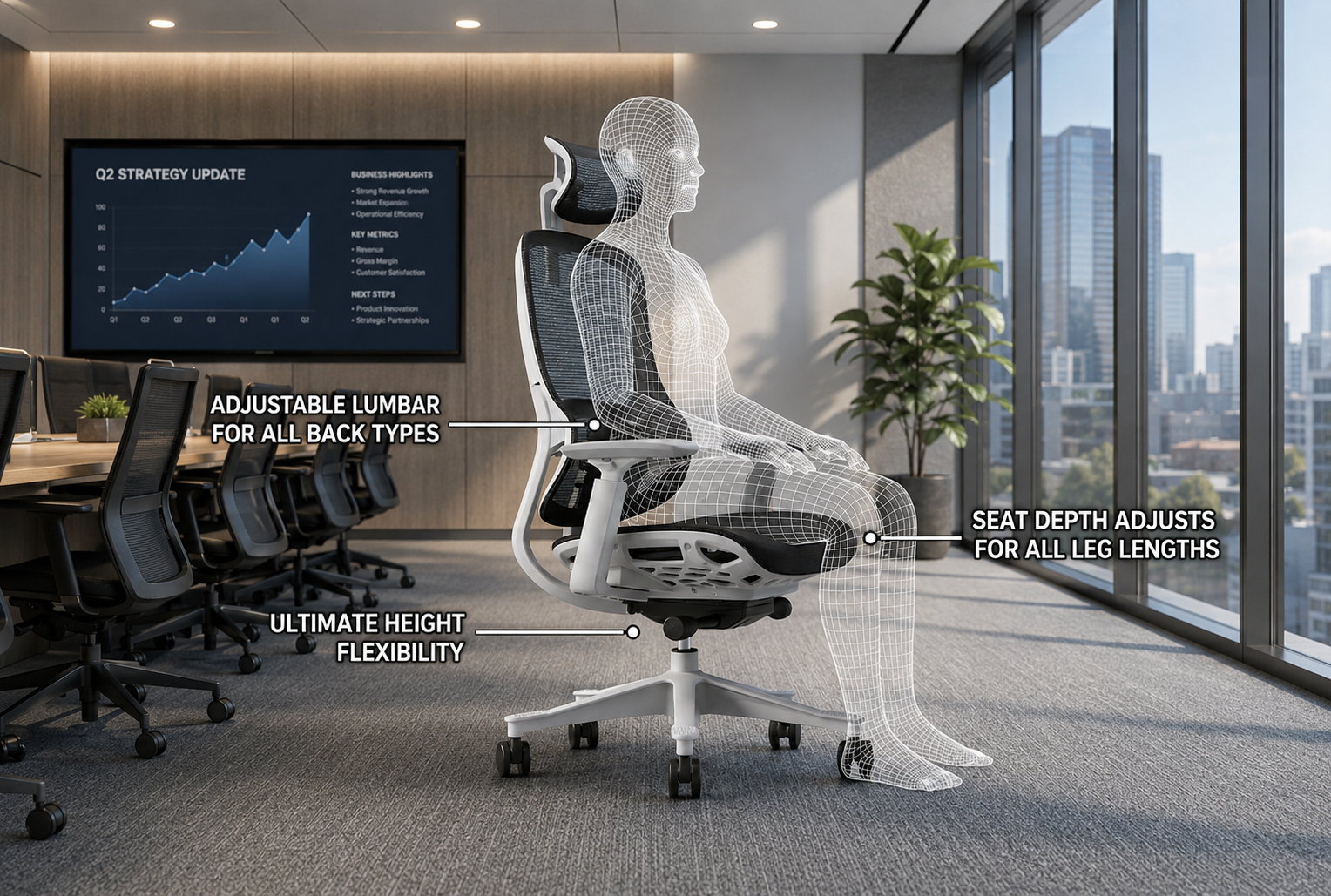
Most people buy an ergonomic chair the wrong way. They read a few reviews, pick something that looks right, and assume that the word ‘ergonomic’ on the listing means it will work for them. It will not, not automatically. An ergonomic chair only delivers on its promise when it fits the specific person sitting in it. A chair built around one set of body proportions will feel uncomfortable and unsupportive to someone built differently, regardless of how many adjustment points it has.
UK office workers spend an average of 1,700 hours per year seated at a workstation. Getting the fit right from the start is far easier than dealing with the discomfort that builds when it is wrong. This guide tells you exactly what to look for based on your body type, so you can make a confident decision rather than an expensive guess.
(Source: Ergonomic Office Chair Dimensions Guide, Boulies, 2026)
Why Adjustment Range Matters More Than a Feature List
Browse any UK office furniture website, and you will find the phrase ‘fully adjustable’ on almost every product page. Seat height adjusts. The back reclines. The armrests go up and down. That sounds like enough. The problem is that the adjustment range matters just as much as the adjustments themselves.
A chair with a seat height range of 44 to 54cm works well for someone of average height. For a person who is 5ft 2in, even the lowest setting may leave their feet off the floor. For someone 6ft 3in, the highest setting may not allow a proper seated position without strain on the hips and legs. According to DSE assessment guidance from Workhappy UK, the seat height, seat depth, backrest height, and weight capacity all need to match your actual body measurements, not a population average the chair was designed around.
Many chairs in the UK market are designed to cover a broad range of buyers rather than to fit any individual precisely. The result is a chair that is acceptable for most people but genuinely well-fitted for very few. What you need is a chair with the right specification range for your build, backed by a standard that holds up over years of daily use.
What to Look For Based on Your Body Type
If you are under 5ft 4in (163cm)
The most common issue for shorter users is a seat that is too high at its lowest setting, paired with a seat depth that is too long. When the seat pan is deep and cannot be shortened, you face two poor options: sit fully back and feel the front edge pressing behind the knees, or sit forward on the edge and lose the backrest support entirely. Neither is workable across a full working day.
What to prioritise: A gas-lift range that starts at 38 to 40cm. A seat depth slide that shortens the effective seat pan by at least 50mm. Armrests that adjust inward as well as up and down, so they actually sit at shoulder width for a smaller frame. A lumbar support with vertical adjustment, so it sits in the curve of your lower back rather than your mid-back.
If you are between 5ft 4in and 5ft 10in (163–178cm)
Standard adjustable chairs are designed around this height range, which means you have the most choice. The risk is assuming that any chair will do simply because you fall in the middle of the population curve. Even within this range, lumbar quality and back tilt make a significant difference to how supported you feel by the end of the afternoon.
What to prioritise: Adjustable lumbar depth, not just height, so the support can be pushed toward your spine rather than sitting passively against the backrest. A back tilt mechanism with tension control so the chair responds to your weight rather than fighting you. 4D armrests covering height, depth, width, and pivot. Even Sit pressure-distribution technology, as found in the JH Chairs Everything Chair, helps reduce the postural shifting that builds up across a long day, even for users within the average range.
If you are between 5ft 10in and 6ft 2in (178–188cm)
Taller users run into a specific set of fit problems. A backrest that ends at shoulder-blade height leaves the upper back without support for hours at a time. A seat that cannot extend deep enough means the thighs are left unsupported from the knee upward, shifting body weight onto the tailbone and creating fatigue in the lower back and hips as the day goes on.
What to prioritise: A high backrest that reaches and supports the upper shoulders. An extended seat depth range of 46 to 52cm with a slide mechanism for fine adjustment. A lumbar support with a wide vertical adjustment range so it can travel high enough to align with your lumbar curve. Seat height that reaches at least 54 to 56cm at its maximum setting.
If you are over 6ft 2in or need a higher weight-rated chair
Standard office chairs are typically rated to around 110 to 120kg. That is a ceiling, not a comfort margin. A chair operating near its rated capacity wears faster, flexes differently under load, and offers less consistent support over time. For users above 100kg or over 6ft 2in, the structural specification of the chair matters as much as its ergonomic features.
What to prioritise: UKAC-5459 certification, which confirms the chair has been independently tested for users up to 23.5 stone (approximately 149kg) in continuous use. The JH Chairs Everything Chair carries this certification. A reinforced five-star base in aluminium or heavy-gauge nylon. Seat height extending to at least 56 to 60cm. A tall backrest that covers the full back from lumbar to upper shoulder.
Quick Reference: Chair Dimensions by Height
Use this as a starting point when comparing chair specifications. For a more precise approach, Workhappy’s four-measurement guide covers popliteal height, seat depth, backrest height, and weight capacity in practical detail.
| Your Height | Seat Height Range | Seat Depth | Key Feature to Prioritise |
| Under 5ft 4in (163cm) | 38–46cm | 40–44cm | Low gas-lift range, seat depth slide, inward-adjusting armrests |
| 5ft 4in – 5ft 10in (163–178cm) | 42–52cm | 43–48cm | Adjustable lumbar depth, 4D armrests, back tilt with tension control |
| 5ft 10in – 6ft 2in (178–188cm) | 46–56cm | 46–52cm | Extended seat depth slide, high backrest, wide lumbar vertical range |
| Over 6ft 2in (188cm+) | 50–60cm | 50–55cm | UKAC-5459 weight rating, reinforced base, tall backrest |
The Features That Genuinely Affect Fit
Most chair listings include a long bullet point list of features. Not all of them carry equal weight when it comes to how well the chair fits your body.
Features that directly affect how a chair fits your body
- Adjustable lumbar depth and height: A lumbar pad that only moves up and down is only half the solution. Without the ability to push it toward the spine, it sits passively and does not make contact with the lower back curve. Look for both vertical adjustment and forward depth control.
- Seat depth slide: This single feature makes more of a difference to shorter and taller users than almost any other. Without it, seat depth is fixed at manufacture, and there is no way to correct the fit between your thigh length and the backrest position.
- Back tilt with tension control: Research published in the Spine Journal in 2025 found that postural variability, the ability to shift and change position throughout the day, is the strongest modifiable factor linked to lower rates of seated discomfort in office workers. A back tilt that adjusts resistance to your body weight supports that movement.
- UKAC-5459 or BS 5459 certification: This confirms independent testing for continuous use at the declared weight capacity. For UK business procurement, particularly for public sector or commercial fit-out projects, it is the standard to ask for before placing any volume order.
Features that matter less than they appear
- Memory foam seat pads: Comfortable in the first few weeks, but the foam compresses over time and loses its support characteristics. Mesh seating or Even Sit pressure-distribution technology holds its performance for far longer under daily use.
- Headrests on task chairs: Useful when reclining away from a screen. During active computer work, a headrest can encourage the head to rest back rather than stay in a forward-facing neutral position. The JH Chairs Everything Chair includes a free headrest as an option, but it is not necessary for standard seated desk work.
- Fabric descriptions and stitch counts: Upholstery affects durability and breathability, both of which matter. But they do not affect ergonomic fit. A well-described fabric on a chair with a poor seat depth range will still not fit your body. Check the adjustment specifications first.
(Source: Vaseat: Ergonomic Sitting Posture and Spinal Health Research 2026)
Why a Specialist Chair Outperforms a Generic One
Many chairs sold through general office furniture retailers are sourced to cover a wide population at a price point that works for volume sales. The result is a chair that is broadly acceptable and precisely right for very few people. When the fit is not right, the chair does not perform as an ergonomic product regardless of what the label says.
A specialist ergonomic seating brand directs its engineering toward the problem of fit across the full range of users. The JH Chairs Everything Chair includes Even Sit technology for uniform pressure distribution across the seat pan, a floating lumbar support that adjusts independently of the backrest, an auto weight-balance mechanism, forward seat tilt, and UKAC-5459 certification for users up to 23.5 stone. That is the specification you are actually looking for when you invest in proper ergonomic seating.
Key Takeaways
- An ergonomic chair only works when it fits your body. Adjustment range matters as much as the number of adjustments available
- Shorter users need a low gas-lift starting point, a seat depth slide, and inward-adjusting armrests as a minimum
- Average-height users benefit most from adjustable lumbar depth and a back tilt with tension control, not just basic height adjustment
- Taller users need a high backrest, extended seat depth, and a lumbar support with wide vertical travel
- Users over 100kg or 6ft 2in should look for UKAC-5459 or BS 5459 certification and a reinforced base before anything else
- Seat depth, slide and adjustable lumbar depth are the two most underrated specifications when comparing chairs
Frequently Asked Questions
How do I know if an ergonomic chair will fit me before buying?
Take four measurements: your popliteal height (floor to the back of your knee), your seat depth (back of knee to your lower back while seated), your hip width, and your seated shoulder height. Compare these against the chair’s published specification ranges. If the chair’s minimum seat height is higher than your popliteal measurement, it will not sit correctly without a footrest.
What should I look for in an office chair if I have lower back discomfort from sitting?
Look for a chair with adjustable lumbar depth, not just height, so the support can be positioned to make proper contact with the lower back curve. A back tilt with tension control allows you to shift position throughout the day, which reduces the build-up of static strain. These are the two features that make the most practical difference for seated comfort over long periods.
What is the best office chair specification for a tall person in the UK?
A seat height that reaches at least 54 to 56cm at its maximum, a seat depth of 46 to 52cm with a depth slide, and a high backrest that provides full coverage from the lumbar region to the upper shoulders. UKAC-5459 certification confirms the chair has been tested under the load and duration requirements appropriate for a larger frame in continuous daily use.
What should shorter people specifically look for in an ergonomic chair?
The minimum seat height is the single most important specification. Look for a chair that drops to 38 to 40cm. Pair that with a seat depth slide so you can shorten the effective seat pan, and armrests that adjust inward so they sit at the right width for a narrower shoulder span. Without these three features, a shorter user will either sit with feet off the floor or perch at the front of the seat, neither of which is a properly supported position.
Does a 10-year warranty on an ergonomic chair actually mean anything?
It does when the brand holds UK stock and has a support network in place. A 10-year warranty from a brand without UK presence or available replacement parts is difficult to redeem in practice. JH Chairs operates from UK stock with a full dealer support network, which means the warranty works as stated rather than existing only on paper.
Conclusion
Choosing an ergonomic chair becomes straightforward once you stop treating it as a style or brand decision and start treating it as a fit decision. Your height, build, leg length, and daily hours at a desk should all influence what you buy. A chair that cannot adjust to your body does not perform as an ergonomic product, regardless of how it is marketed. The right chair at the right specification does exist at an accessible price point. If you are ready to find seating that is built around your body rather than a broad population average, browse the JH Chairs Ergonomic Office Chair and speak to the team. We supply dealers, procurement teams, and commercial fit-out companies across the UK with next-day dispatch and a standard warranty included.