
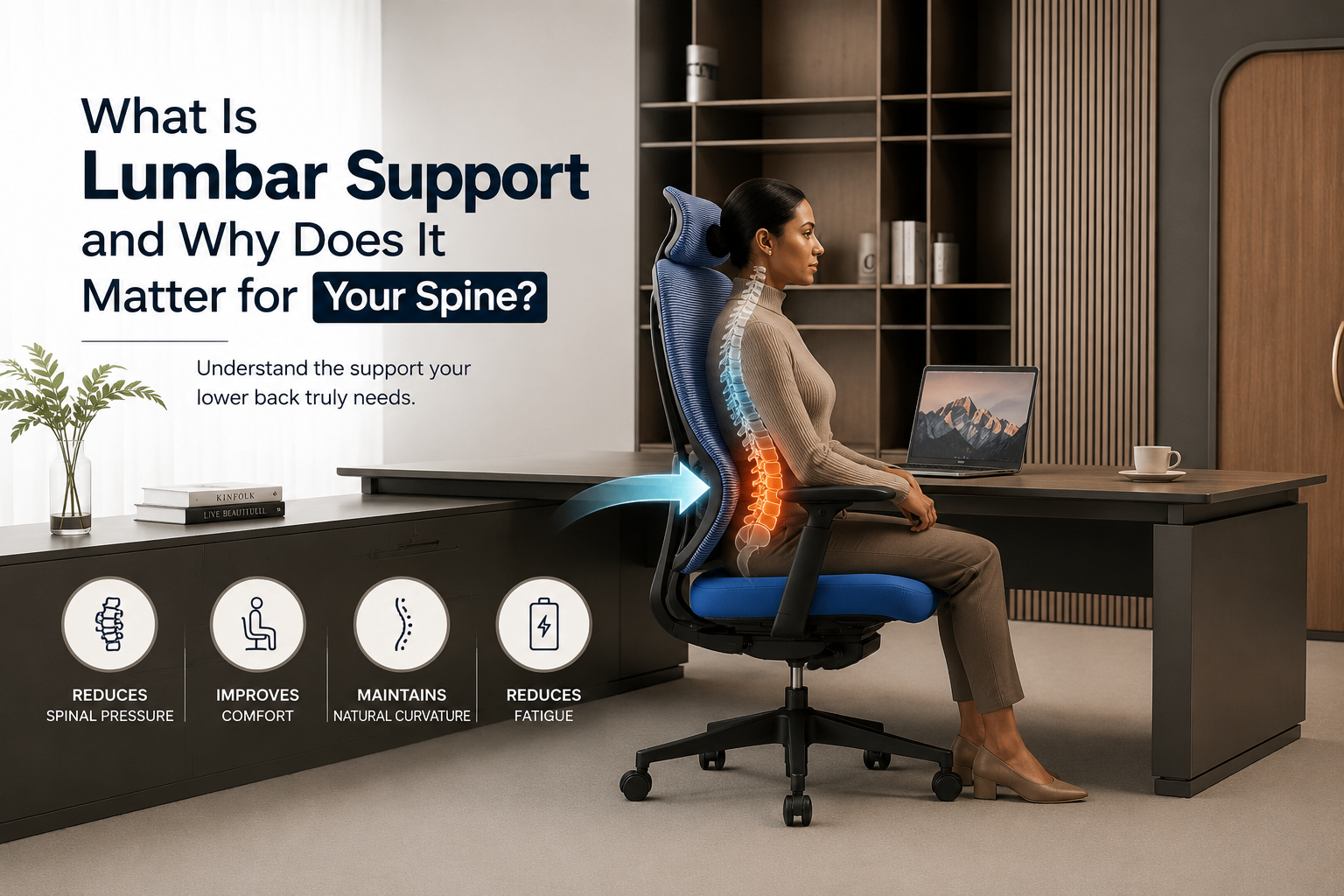
Lumbar support is the most talked-about feature in ergonomic seating and also one of the most misunderstood. Most people know they are supposed to want it. Far fewer understand what it actually does, why its position matters, or why the type of lumbar system on a chair makes more difference than whether one exists at all.
In the UK, many employees experience lower back discomfort, and nearly a million working days are lost to back-related issues every year. The majority of those cases involve people who sit at a desk for most of their working day. The chair they are sitting in, and specifically how well it supports the lower back, is one of the primary variables that determines whether those hours are comfortable or not.
Source: Comfort Global: The Science Behind Lumbar Support on Ergonomic Office Chairs
What Does Lumbar Support Actually Do?
The lumbar region is the lower part of the spine, roughly the five vertebrae that sit between the ribcage and the pelvis. In a healthy standing posture, the lower back has a natural inward curve called the lordotic curve. When you sit down without any support, that curve tends to flatten or reverse. The lower back rounds outward, the pelvis tilts backward, and the muscles around the spine take on the work of holding the whole structure in place.
Over an hour, that is manageable. Over eight hours, day after day, it builds into the kind of fatigue and stiffness that most desk workers accept as normal. It is not normal. It is the result of asking the muscles and soft tissues of the lower back to do sustained work they were not designed to do continuously.
Lumbar support fills the gap between the chair’s backrest and your lower back, maintaining that natural inward curve without any muscular effort on your part. When it is positioned correctly and makes genuine contact with the lower back, the spine stays in a more neutral alignment and the surrounding muscles can relax rather than brace. A study published on PubMed examining office chair design features found that lumbar support combined with correct seat pan positioning produced the most neutral spinal and pelvic posture of all the chair configurations tested.
Not All Lumbar Support Is the Same
Walk into any office furniture supplier and every chair on the floor will have ‘lumbar support’ on its product sheet. What that phrase actually covers varies significantly. There is a real and practical difference between a fixed moulded pad and a floating independent lumbar system, and that difference is felt across every hour of the working day.
| Lumbar Type | How It Works | Limitation |
| Fixed lumbar pad | Moulded into the backrest at one height | Cannot be repositioned for different users or body types |
| Height-adjustable pad | Moves up and down on a rail behind the backrest | No depth control, so contact depends on how far back you lean |
| Adjustable depth + height | Moves vertically and pushes forward toward the spine | Requires initial setup — but once set, works without thinking about it |
| Floating lumbar support | Moves independently of the backrest and adapts as you recline | Found on specialist ergonomic chairs; not typical on budget seating |
Source: Workhappy UK: Will Your Chair Fit You?
The most important upgrade between basic and specialist lumbar systems is independence from the backrest. On many chairs, the lumbar pad is built into the backrest frame. When you recline, the entire back moves as one unit and the lumbar pad moves away from your lower back along with it. A floating lumbar support is mounted independently. It stays in contact with the lower back across the recline range, so support does not disappear every time you shift position.
What Good Lumbar Support Actually Feels Like
This is something that rarely gets described clearly. Good lumbar support does not feel like pressure. It does not push your back forward or force you into a particular posture. When it is set correctly, you should not feel it at all in the sense of pressure or tension.
What you should notice is the absence of strain. After an hour in a properly set chair, the lower back does not ache. You do not feel the urge to shift forward on the seat or lean to one side. You do not stand up stiff. The support is doing passive work in the background, maintaining the curve that would otherwise flatten and cause the surrounding muscles to brace.
Research published through an ergonomic assessment of home office setups found that many remote workers lack adequate lumbar support in their home working setup. Among those using dining chairs and non-ergonomic seating, lower back discomfort rates were higher over six-month periods compared to workers using properly specified ergonomic seating.
Source: Houseloo: Office Chair Health Impact Ergonomic Assessment Report 2026
Key Takeaways
- Lumbar support maintains the natural inward curve of the lower back, allowing the surrounding muscles to relax rather than brace during prolonged sitting
- Not all lumbar support is equal: fixed pads, height-adjustable rails, depth-adjustable systems, and floating independent supports each perform very differently in daily use
- Position matters more than presence: a lumbar pad in the wrong place does nothing useful and can be actively uncomfortable
- Floating lumbar support that moves independently of the backrest maintains contact through the full recline range, which fixed and rail-mounted systems cannot
- Most of the UK employees experience back discomfort and 34 per cent of remote workers lack adequate lumbar support in their home setup
- The right chair for lower back support has independent vertical and depth lumbar adjustment, not just a pad moulded into the backrest
Frequently Asked Questions
What is lumbar support on an office chair?
Lumbar support is a component of the chair backrest designed to fill the natural gap between the chair and the lower back when seated. It maintains the inward curve of the lumbar spine so the surrounding muscles do not have to hold the posture actively. The quality, adjustability, and independence of the lumbar system determines how effective it is in practice.
Where should lumbar support sit on your back?
It should sit in the lower back, specifically in the curve between the top of the pelvis and the base of the ribcage. If you place your hand between your lower back and the chair while sitting fully back, the gap you feel is where the support should be. Lumbar support positioned in the mid-back or upper back is in the wrong place and will not support the lumbar curve.
What is a floating lumbar support?
A floating lumbar support is mounted independently of the backrest frame rather than being fixed to it. This means it maintains its position relative to your lower back when you recline, rather than moving away from the spine as the backrest tilts back. The JH Chairs Everything Chair uses this system, with the support targeting both the lumbar spine and the psoas muscles on either side.
Does lumbar support actually make a difference to how comfortable a chair is?
Yes, when it is set correctly and makes genuine contact with the lower back. The PubMed review of chair design features found that lumbar support combined with correct seat positioning produced the most neutral spinal and pelvic posture of all configurations tested. The key is that the support must be positioned at the right height and must make actual contact with the lower back, which requires both height and depth adjustability.
Conclusion
Lumbar support is not a feature to check off a list when buying an office chair. It is the mechanical reason a well-designed chair feels different to sit in after four hours at a desk. When it works correctly, you do not think about your lower back at all. When it does not, that absence accumulates as restlessness, fatigue, and stiffness that most desk workers accept without questioning. The difference between basic and specialist lumbar systems is real and is felt every working day. If you are looking for a chair built around a lumbar system that genuinely adapts to your body and your posture, explore the ergonomic office chairs with their floating independent lumbar support. Available from UK stock with next-day dispatch and a 10-year warranty as standard.