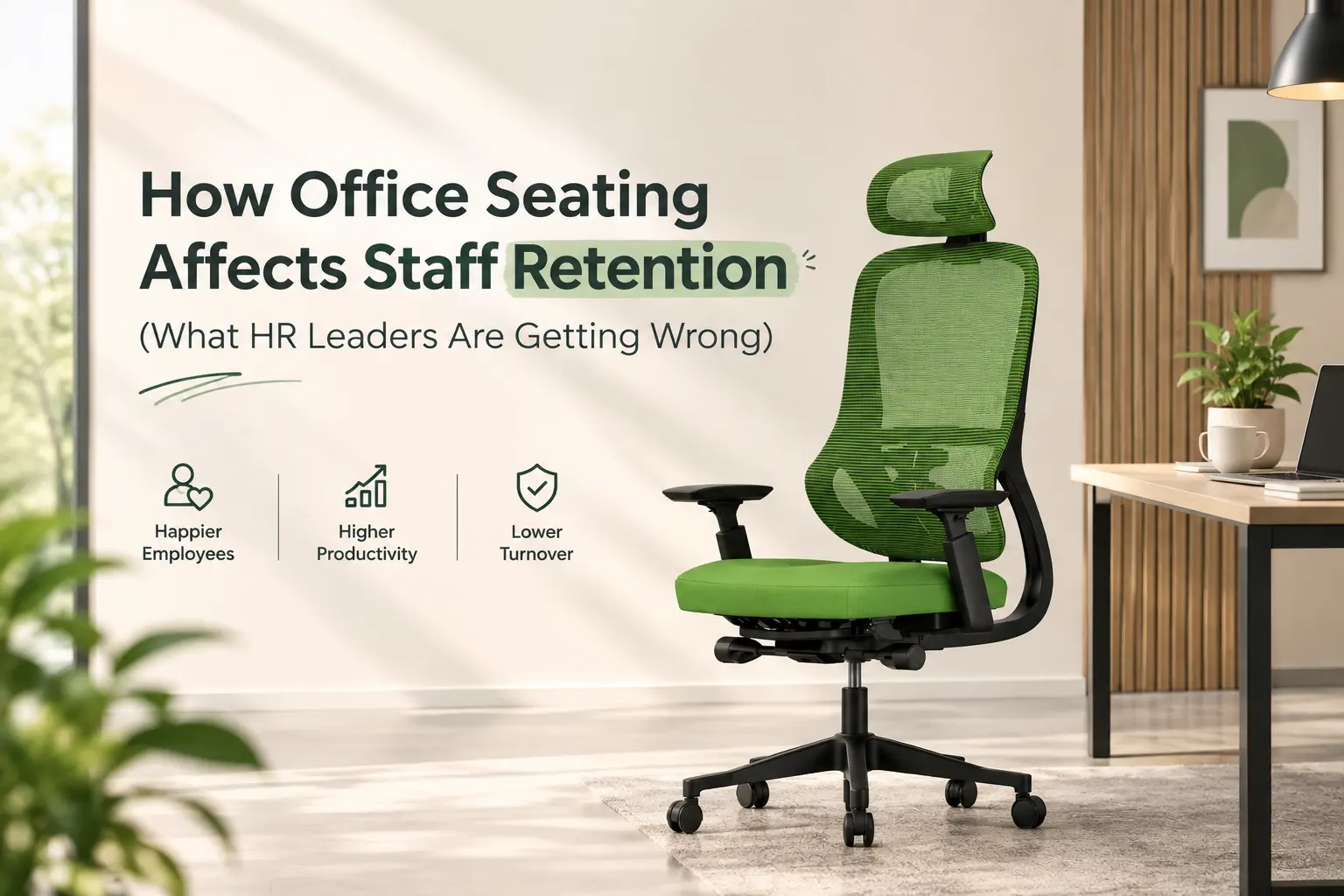
Most retention strategies focus on the big, visible things. Salary benchmarking, flexible working policies, learning budgets, wellbeing programmes. All genuinely important. All frequently discussed at board level.
The chair someone sits in for eight hours a day is almost never part of that conversation. It should be. Not because it replaces the bigger initiatives, but because it undermines them quietly if it is ignored, and very few HR strategies account for that.
What Are Most Retention Strategies Missing?
Retention strategy tends to focus on the things people talk about when they explain why they leave: pay, progression, management, culture. Those exit interview themes are real, but they capture what people are willing to name, not everything that shaped how they actually felt at work day to day.
Physical comfort rarely appears in an exit interview because nobody frames it that way. Nobody says they left because their chair was uncomfortable. But sustained daily discomfort contributes to fatigue, distraction, and a general sense that a workplace has not invested properly in the people working there, and that sense shows up in engagement long before it ever shows up as a stated reason for leaving.
Nobody resigns because of a chair. But a chair that quietly makes every working day slightly worse is exactly the kind of thing that erodes engagement without ever appearing as a named cause.
Why Should This Be a Board-Level Conversation, Not a Facilities One?
Office furniture is usually owned by facilities or operations, sitting outside HR’s remit and rarely discussed as part of an employee experience strategy. That separation is the mistake. Facilities decisions and HR outcomes are more connected than the org chart suggests.
Employee experience is shaped by every touchpoint someone has with their workplace, and the physical environment is one of the most constant. A wellbeing programme or a flexible working policy is felt occasionally. The chair is felt every single working day. Our guide on how workplace wellbeing begins with intelligent seating covers this connection in more depth.
Treating seating as a pure facilities line item, decided on unit cost alone, misses the fact that it is also an employee experience decision with retention consequences. It deserves the same strategic attention as any other part of the working environment HR is accountable for shaping.
What Does Getting This Wrong Actually Cost?
The cost rarely shows up where anyone is looking for it. It distributes across small, cumulative effects: slightly lower engagement, a slightly less positive office impression, a slightly higher baseline of minor complaints. None of it is dramatic on its own. All of it adds up.
There is also a compounding effect worth naming directly. Comfort during the working day affects concentration and output, which our guide on how an ergonomic chair boosts productivity covers in more detail. A workplace that is quietly less comfortable to work in is also a workplace that is quietly less productive, and both of those things feed into how people talk about the organisation, internally and externally.
None of these costs will ever appear as a single line item labelled seating. That is exactly why they are so consistently under-prioritised against more visible retention spend.
What Does Getting This Right Actually Look Like?
This does not require an enormous budget shift. It requires recognising the seating decision as part of the employee experience remit rather than a pure procurement task, and applying the same rigour to it that HR already applies elsewhere.
- Involve HR or people teams in seating decisions, not just facilities or procurement working alone
- Look for independent certification and genuine adjustability rather than unit price as the primary buying signal
- Treat DSE assessment findings as employee experience data, not just a compliance checkbox
- Ask staff directly what is and is not working with their current setup, rather than assuming
- Budget for seating as part of a retention and wellbeing conversation, not purely a facilities refresh cycle
This shift in framing changes how the decision gets made. Our guide to choosing office chairs for large teams covers the practical side of this, and our guide to what makes an office chair truly ergonomic covers the specific features worth prioritising once HR is part of the conversation.
Is There a Practical Starting Point for HR Teams?
Yes, and it already exists in most organisations. DSE risk assessments are a legal requirement across the UK and Ireland and are usually treated as a pure compliance exercise. They are also, functionally, a structured source of employee experience data that most HR teams never look at.
A pattern of repeated chair-related findings across DSE assessments is a direct signal about where the physical environment is falling short. Reviewing that data through an employee experience lens, not just a compliance one, gives HR teams a practical, low-effort way to bring seating into the retention conversation without starting a new initiative from scratch.
Frequently Asked Questions
Does office furniture actually influence staff retention?
It contributes to the broader employee experience, which is a genuine factor in retention, though it works alongside pay, management, and culture rather than instead of them. Physical comfort in the workplace rarely appears as a stated reason for leaving, but it affects engagement and day-to-day satisfaction, which are themselves connected to retention outcomes.
Should HR be involved in office furniture procurement decisions?
There is a strong practical case for it, at least in an advisory capacity. Facilities and procurement teams focus on cost, delivery, and logistics, which are all genuinely important. HR brings a different lens: how the decision affects employee experience and engagement. Combining both perspectives tends to produce a better outcome than either working in isolation.
How can HR teams justify spending more on office chairs?
The clearest argument is total cost of ownership combined with employee experience impact, rather than seating in isolation. A certified chair with a genuine long-term warranty costs less over its full service life than a cheaper chair replaced repeatedly, and it also avoids the cumulative engagement cost of poor daily comfort. Our guide to ergonomic office chair benefits covers this case in more detail.
What is the simplest first step for an HR team to take on this?
Review recent DSE assessment findings with an employee experience lens rather than only a compliance one. If chair-related issues are appearing repeatedly, that is a concrete, existing data point that can support a wider conversation about seating investment without needing to launch a new survey or initiative.
A Better Workplace Starts With What People Sit On
Retention strategy will always be about more than furniture. But a workplace that gets the small, constant things right, including the chair someone sits in for eight hours a day, sends a signal about how much genuine thought has gone into the whole employee experience. That signal matters more than most HR strategies currently account for.
If seating has not yet been part of your retention conversation, it is worth starting there. Explore the JH Chairs ergonomic range, built with certified durability and genuine ergonomic design. Next-day dispatch is available across the UK and Ireland, with no minimum order required, making it straightforward to start with a pilot before committing to a wider rollout.