
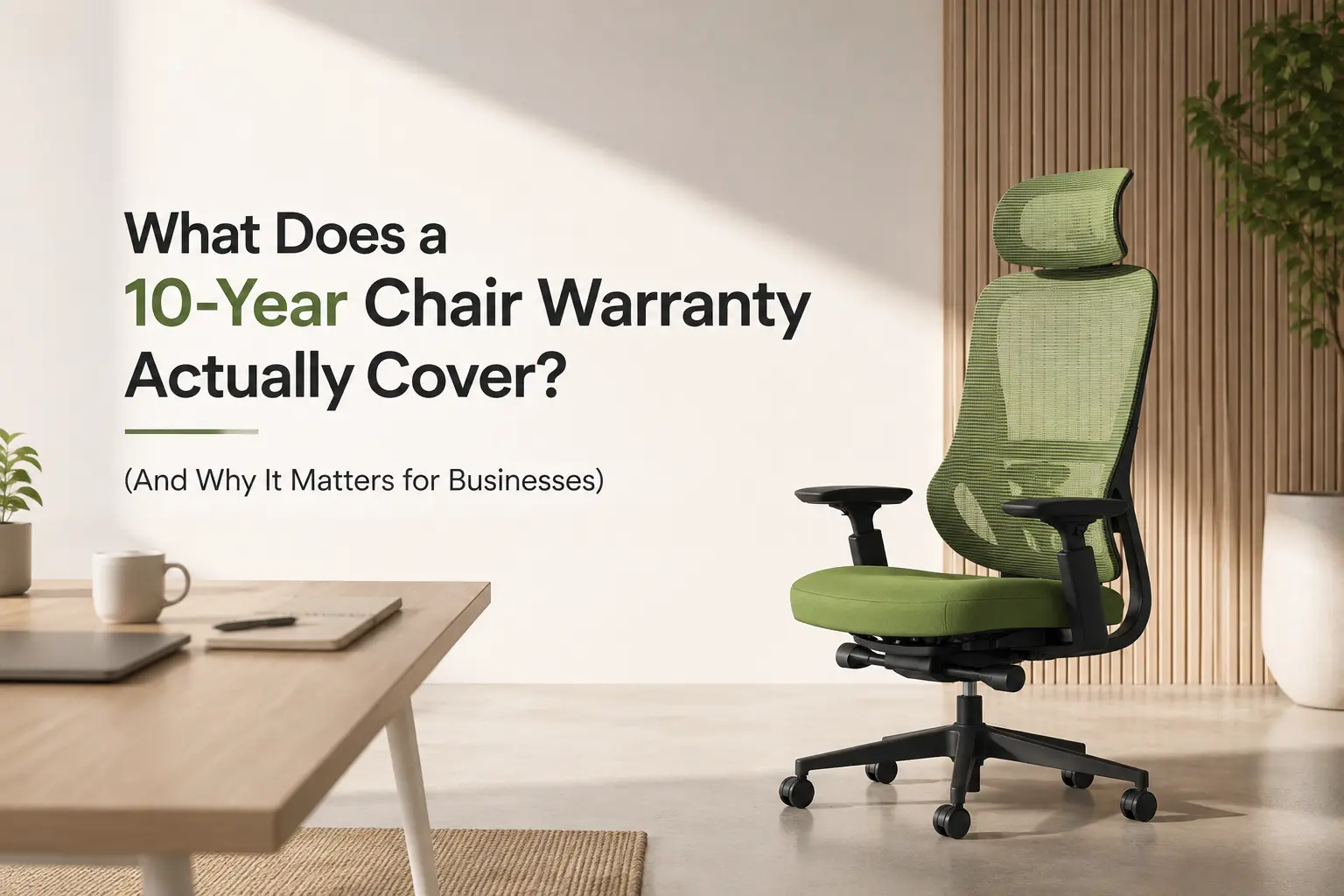
A ten-year warranty gets mentioned a lot in office chair marketing. It sounds impressive. But most buyers never stop to ask what it actually covers, or more importantly, what it does not.
That distinction matters. A warranty is a statement of confidence from the manufacturer. A long one, genuinely meant, tells you something real about how the chair is built. A short or heavily conditional one tells you something too. This guide unpacks what to look for, what to ask, and why the length of a warranty is one of the more reliable quality signals available when you are buying commercial office seating.
Why Does Warranty Length Tell You Something About the Chair?
Manufacturers set warranty periods based on how long they expect their product to last. A two or three year warranty is standard at the budget end of the market. It means the chair will likely hold together for that window, and not much beyond it.
A ten-year warranty is a different kind of commitment. It means the manufacturer is prepared to cover repair or replacement for a decade, which is only commercially viable if the chair is engineered to last that long. Nobody offers a ten-year warranty on a product they expect to fail in year four.
For businesses buying chairs that will be used intensively across long working days, that engineering confidence matters. Our guide to ergonomic chairs for all-day use covers what sustained daily use actually demands from a chair’s construction.
A short warranty is not always a sign of a bad chair, but a long one is almost always a sign of a manufacturer who has done the work to build something that can back it up.
What Does a 10-Year Office Chair Warranty Typically Cover?
The specifics vary by manufacturer, but a well-structured ten-year warranty on a commercial office chair should cover the following:
Structural frame
The base, backrest frame, and seat pan should be covered against manufacturing defects and structural failure under normal use. This is the core of any long-term warranty.
Mechanism and adjustment components
The recline mechanism, height adjustment cylinder, tilt lock, and armrest adjustments should all be covered. These take the most mechanical stress over time and are the first to show up manufacturing weaknesses.
Castors and base
Five-star bases and castors are often excluded from shorter warranties because they take direct impact. A ten-year warranty that includes these components reflects genuine confidence in their durability.
Foam and upholstery
Foam and upholstery are the components most likely to carry a shorter coverage window or extra conditions within an otherwise long warranty. Always check whether these are covered for the full term and whether normal wear is excluded. Our office chair maintenance guide covers basic care that extends upholstery and foam life considerably.
Always read what the warranty excludes as carefully as what it includes. The exclusions are where the real difference between a genuine ten-year commitment and a marketing claim tends to show up.
What Is Usually Not Covered by an Office Chair Warranty?
Most warranties, regardless of length, exclude certain things as standard. Understanding these exclusions matters before you decide a warranty is as comprehensive as it sounds.
- Damage caused by misuse or use outside the stated weight capacity
- Cosmetic damage that does not affect function, including surface scratches, minor scuffs, or fabric fading from sunlight
- Normal wear and tear on upholstery, foam, and finish over time
- Damage resulting from improper assembly or modification by the buyer
- Failure caused by inadequate maintenance, where the manufacturer provides care guidelines
For businesses running shared workstations, it is particularly worth checking the weight capacity and whether the warranty covers multi-user environments. A chair certified to UKAC-5459 or BS 5459 Part 2 has been tested for exactly this kind of sustained, multi-occupancy use. Our guide to DSE workstation compliance explains why certification and warranty together give you the strongest compliance position.
Why Does This Matter More for Businesses Than Individual Buyers?
When you are buying one chair for yourself, a warranty is reassurance. When you are buying twenty or fifty chairs for an office, it becomes a financial and operational calculation.
Early replacements across a larger office estate add up quickly: additional orders, delivery logistics, and gaps in your setup while you wait. The cost difference between a two-year and a ten-year warranty compounds across every replacement cycle. Our guide to choosing office chairs for large teams covers total cost of ownership in more detail.
A chair that degrades within two or three years of daily use stops supporting people properly before the replacement cycle arrives. That has a direct effect on back comfort, posture, and the working environment you are providing.
For procurement teams, the warranty is not just about what happens if something breaks. It is a proxy for how long the chair will actually perform at the standard you bought it for.
How Do You Know If a Warranty Claim Is Genuine?
A few things separate a genuine ten-year commitment from one that reads well in a brochure but is hard to claim against.
- Is the warranty registered automatically, or does it require the buyer to register within a short window after purchase? Unregistered warranties that lapse are a common trap.
- Who do you contact to make a claim? A clear, named process with direct contact information is a better sign than a general customer service address.
- Is the warranty backed by a manufacturer with a demonstrable track record? A new market entrant offering a ten-year warranty is making a promise on thinner ground than an established supplier who has been honouring those claims for years.
- Is the certification independent? A chair certified to UKAC-5459 has been externally tested, which adds credibility to the durability claims the warranty is built on.
The benefits of ergonomic seating are only realised if the chair maintains its support and integrity over the years you are using it. Independent certification, Circular Design accreditation, and a clear claims process all add weight to a warranty claim.
Frequently Asked Questions
How long should a good office chair last?
A well-built commercial office chair should last seven to ten years in normal use, and longer with basic maintenance. Budget chairs at the lower end of the market often degrade noticeably within two to three years, particularly the foam and mechanical components. Our office chair maintenance guide covers the simple steps that extend service life considerably.
Does a 10-year warranty mean the chair will last 10 years?
Not automatically. It means the manufacturer is prepared to repair or replace the chair if it fails due to defect within that period, under normal use conditions. A ten-year warranty backed by independent certification and a track record of quality is a stronger indicator than a warranty claim alone.
Is a 10-year warranty standard for commercial office chairs?
No. Most chairs at the lower and mid-range of the market carry two to five year warranties. Ten years is genuinely unusual and reflects a higher standard of construction. When you see it alongside independent certification like UKAC-5459, it is a meaningful quality signal.
What should I do if I need to make a warranty claim?
Contact the supplier directly with your proof of purchase and a description of the fault. A reputable supplier will have a clear claims process. At JH Chairs, warranty claims are handled directly and straightforwardly. There is no complex registration process or narrow claims window to navigate.
Does the warranty cover chairs used in a shared or hot-desking environment?
This varies by supplier. At JH Chairs, the warranty covers chairs used in commercial environments including shared workstations. Chairs certified to UKAC-5459 have been tested specifically for multi-occupancy use, which means the warranty is grounded in testing that reflects how the chair is actually being used.
A Warranty Is a Promise. Make Sure It Is One the Supplier Can Keep.
Ten years is a long time to stand behind a product. The manufacturers who do it are the ones who have built something worth standing behind. For businesses making a purchasing decision that will affect how their team sits every day for the next decade, that matters.
Every chair in the JH Chairs range carries a ten-year warranty, is certified to UKAC-5459 standards, and is available with next-day dispatch across the UK and Ireland. If you are looking for ergonomic office seating you can rely on for the long term, explore the full range at jhchairs.co.uk. No minimum order required.