
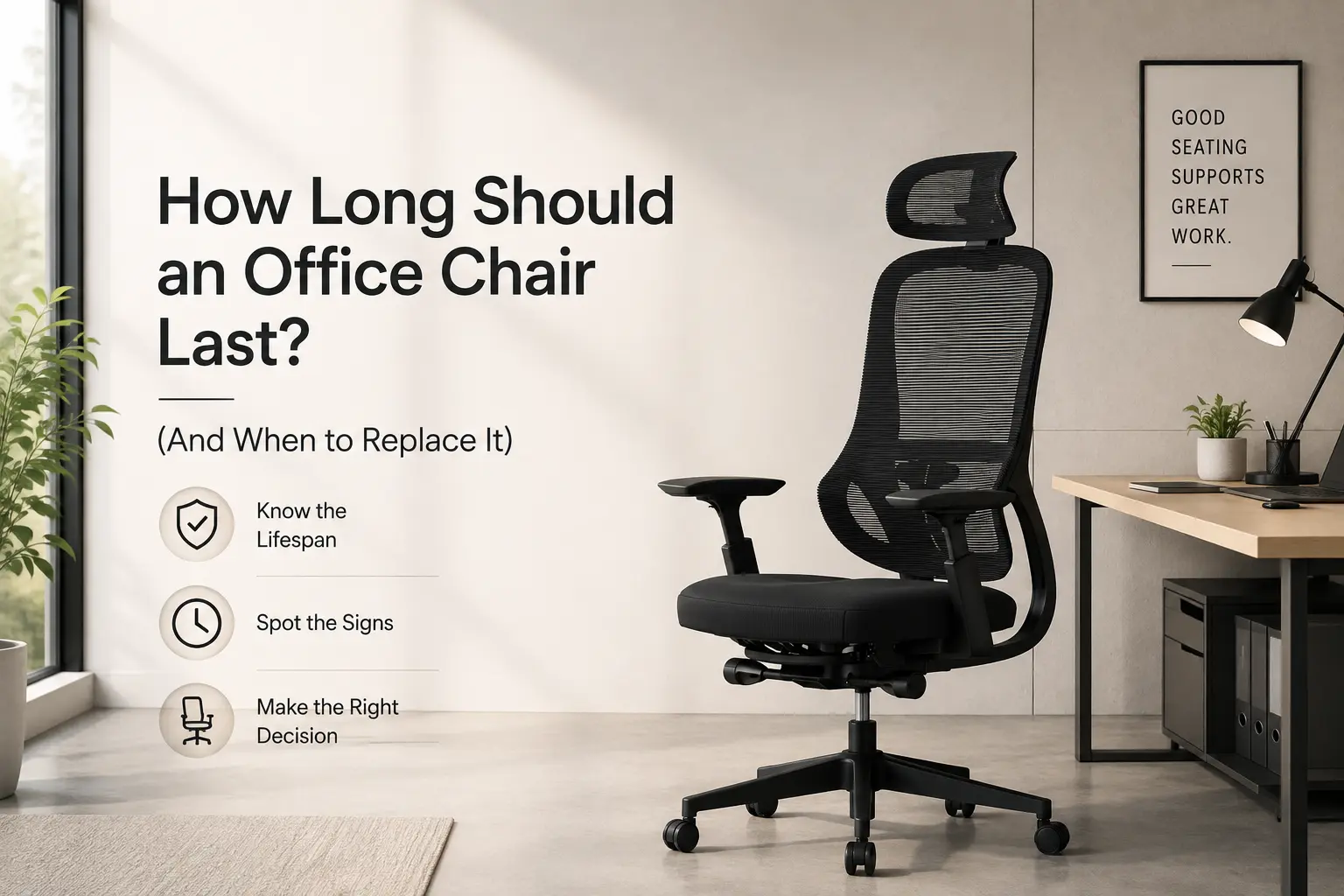
Most people replace their office chair when it becomes obviously unusable. Something cracks, a mechanism fails, or the foam has flattened to the point where sitting in it is uncomfortable. By then, the chair has usually been quietly underperforming for a long time before anyone acted on it.
Knowing the expected lifespan of a well-made chair gives you a more useful benchmark than waiting for visible failure. It also gives commercial buyers something concrete to justify a replacement decision against, rather than relying on a general sense that things feel a bit worn.
How Long Should an Office Chair Actually Last?
A well-built commercial office chair should last seven to ten years under normal daily use. That figure assumes a chair constructed to a genuine commercial standard, with quality foam, a durable mechanism, and a frame built to handle continuous use rather than occasional sitting.
Budget chairs at the lower end often fall well short. Noticeable degradation within two to three years is common, particularly in the foam and recline mechanism, the two components under the most consistent mechanical stress.
The gap between these two figures is not accidental. It reflects real differences in materials, engineering, and testing. Chairs certified to UKAC-5459 or BS 5459 Part 2 have been independently tested for durability under sustained load, which is one of the more reliable indicators of whether a chair will actually reach the upper end of that lifespan range. Our guide to office chair benefits covers what genuine build quality contributes beyond just comfort.
Lifespan is not just a comfort question. It is a direct input into how you calculate the real cost of a chair over time, and whether the cheaper option at purchase is actually the cheaper option overall.
What Actually Determines How Long a Chair Lasts?
Foam density and quality
Foam is usually the first component to show its age. Lower-density foam compresses permanently within months of daily use, losing its ability to support weight evenly. Higher-density foam used in commercial-grade seating holds its shape for years longer under the same conditions.
Mechanism build quality
The recline mechanism, height adjustment cylinder, and tilt lock all take repeated mechanical stress every single day. Cheaper mechanisms are more prone to sticking, loosening, or failing outright after a few years of regular use. This is one of the clearest points of difference between budget and commercial-grade seating.
Frame and base construction
The main frame and five-star base need to withstand continuous weight-bearing and movement without developing cracks or loose joints. Materials and construction quality here determine whether a chair remains structurally sound at year eight or feels unstable well before that.
Usage intensity
A chair used by one person for standard office hours will typically outlast one used across multiple shifts or by different people in a hot-desking environment. This is why BS 5459 Part 2 specifically tests for multi-occupancy conditions, a more demanding scenario than single-user testing.
What Are the Signs a Chair Needs Replacing?
A chair rarely fails all at once. It degrades gradually, and the signs are often easy to dismiss individually even though together they paint a clear picture. Our guide to signs you need a new office chair covers this in detail, but the most common indicators are:
- Visible or felt compression in the seat cushion, where the foam no longer springs back after sitting
- A recline or height mechanism that sticks, slips, or no longer holds its position reliably
- Increasing discomfort by the end of the working day that was not previously noticeable in the same chair
- Wobbling, creaking, or instability in the base or frame
- Fabric or mesh that has stretched, torn, or lost its structural tension
If discomfort is the main symptom you are noticing, it is worth checking whether the issue is the chair itself or how it has been set up. Our guide to signs your office chair is causing back pain helps distinguish between the two.
A single worn chair is easy to overlook. A pattern of the same issues appearing across a whole batch bought at the same time is a signal that the batch, not the individual chair, is the problem.
How Do You Justify Replacing Chairs Before They Completely Fail?
For commercial buyers, waiting until a chair is visibly broken is rarely the most cost-effective approach. A chair that is degrading but not yet failed is already underperforming, contributing to discomfort, complaints, and reduced comfort for whoever is using it, well before it needs replacing outright.
The more useful framework for justifying replacement spend is total cost of ownership rather than waiting for visible failure. A batch of chairs approaching the end of a reasonable lifespan, particularly ones without a long warranty remaining, represents a known future cost. Replacing proactively with certified, longer-warrantied seating converts an unpredictable ongoing cost into a single, planned decision. Our guide to choosing office chairs for large teams covers how to build that comparison into a procurement decision.
There is also a compliance angle. Chairs that no longer adjust properly or that have degraded past useful support are a documented issue the next time a DSE risk assessment is carried out. Replacing before that point avoids the risk being flagged as an open compliance gap.
Frequently Asked Questions
What is the average lifespan of an office chair?
A well-built commercial office chair typically lasts seven to ten years under normal daily use. Budget chairs often need replacing within two to three years due to foam compression and mechanism failure. The gap reflects genuine differences in materials, construction, and independent testing standards.
Does a longer warranty mean a chair will last longer?
Generally, yes. Manufacturers set warranty length based on how long they expect a product to perform without failure, so a ten-year warranty reflects genuine confidence in the build quality. It is not an absolute guarantee, but it is one of the more reliable indicators available when comparing options.
Should chairs be replaced on a fixed schedule or based on condition?
A combination of both works best for most businesses. Setting an expected replacement window, based on manufacturer guidance and warranty length, helps with budgeting and planning. Within that window, condition-based indicators such as foam compression, mechanism reliability, and comfort complaints should still guide the actual timing of replacement.
Is it worth repairing an office chair rather than replacing it?
It depends on the fault and the age of the chair. A mechanism issue on an otherwise sound chair within its warranty period is usually worth repairing or replacing under warranty. Structural issues, significant foam compression, or a chair approaching the end of its expected lifespan are usually better addressed with replacement. Our office chair maintenance guide covers simple upkeep that can extend a chair’s useful life before repair or replacement becomes necessary.
Key Takeaways
- A well-built commercial chair should last seven to ten years, while budget chairs often need replacing within two to three
- Foam density, mechanism quality, and frame construction are the main factors that determine actual lifespan
- Chairs degrade gradually, so watch for compression, mechanism issues, and instability rather than waiting for total failure
- Total cost of ownership is a better replacement justification than waiting until a chair completely breaks
- Independent certification and genuine long-term warranties are reliable indicators of whether a chair will actually reach its expected lifespan
Planning Ahead Rather Than Reacting
Chair lifespan is not just a maintenance detail. For businesses, it is a planning input that affects budgeting, compliance, and the day-to-day experience of everyone sitting in that chair. Knowing what a genuine seven to ten year lifespan looks like, and what shortens it, makes replacement decisions easier to justify and easier to time correctly.
If your current chairs are approaching the end of a reasonable service life, or a batch is showing the early signs of wear, explore the JH Chairs ergonomic range. Every chair is certified to UKAC-5459 standards and backed by a ten-year warranty, with next-day dispatch available across the UK and Ireland and no minimum order required.