
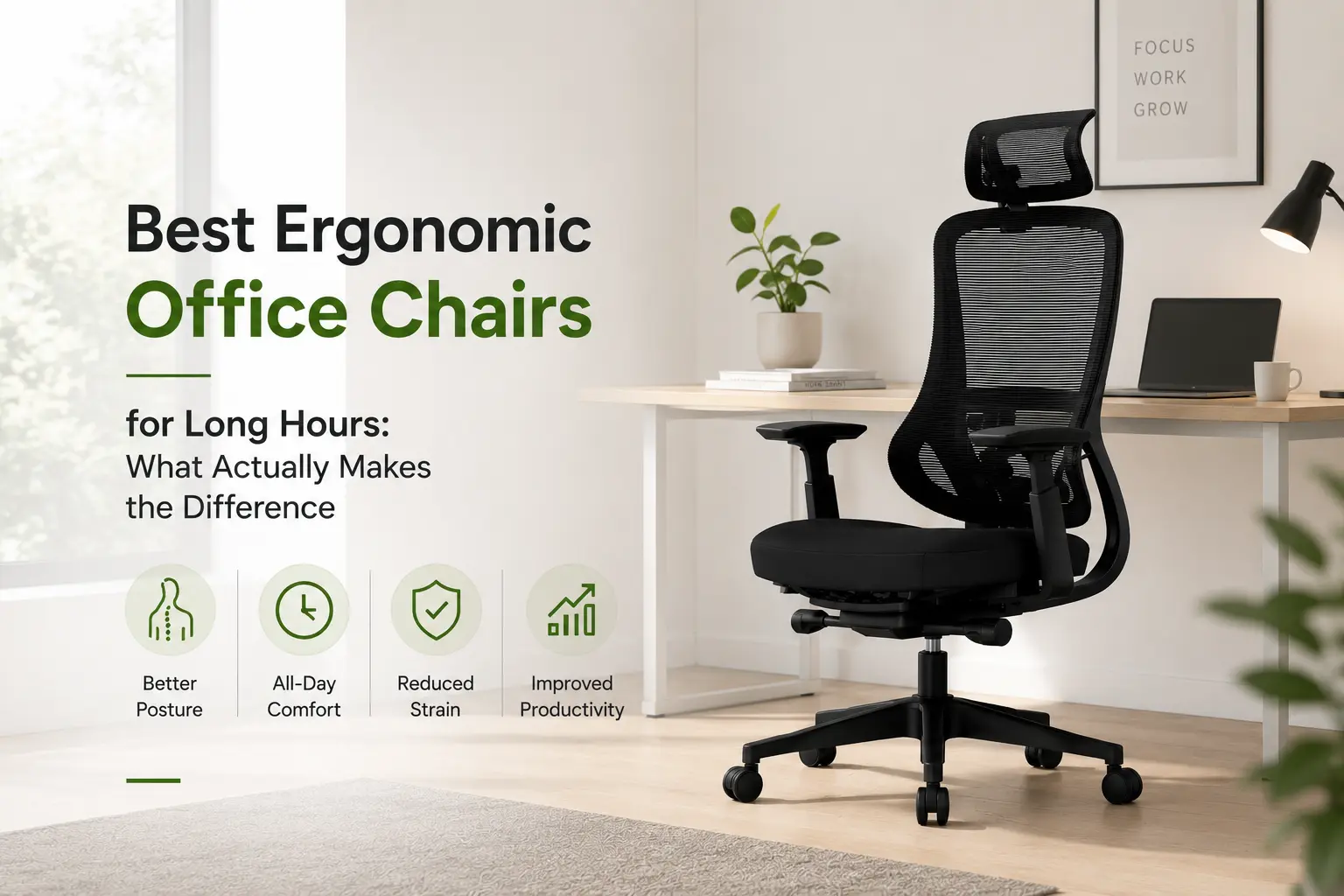
Eight hours is a long time to sit in anything. Do it five days a week and your chair stops being a piece of furniture and starts being something that actively affects how you feel, how you concentrate, and whether your back holds up by Friday afternoon.
The phrase ergonomic gets used loosely on a lot of product listings. It can mean almost anything or sometimes very little. So rather than a roundup of options, this guide focuses on what actually separates a chair that works well for long hours from one that just looks like it should.
Why Long Hours Change What You Need From a Chair
A chair that is comfortable for thirty minutes might cause real problems over eight. The difference comes down to how your body loads the structure of the seat and backrest over time, and whether the chair can actually keep up.
When you sit, the pressure on your lower spine increases significantly compared to standing. Without proper support, that pressure compounds over hours, contributing to fatigue, poor circulation, and the kind of lower back discomfort that is among the most common complaints among desk-based workers across the UK and Ireland.
The chair is only part of the picture. How you sit matters too. Our guide on how to sit correctly in an office chair covers the posture habits that make any chair work harder for you.
A chair that feels fine in a showroom or on day one can tell a very different story after three months of daily eight-hour use. The quality of the engineering shows up over time, not at first sit.
What Should You Actually Look for in a Chair Built for Long Hours?
Lumbar support that stays in contact
This is the single most important feature for anyone sitting for extended periods. The lumbar region of your spine has a natural inward curve, and a chair that does not support it will cause you to gradually slouch forward as muscles fatigue. Fixed lumbar pads are better than nothing, but a floating lumbar support that follows your movement is considerably more effective. Our guide on what lumbar support actually does explains the difference in detail.
Recline that responds to your body
Most chairs have a recline tension dial that is supposed to be adjusted to match your body weight. Most people never touch it, which means the chair either resists movement or collapses backward with very little resistance. Neither is right. A weight-balanced mechanism like Even Sit adjusts automatically, so the chair feels right for whoever sits down without any manual setup.
Seat depth and height you can actually set
Your feet should sit flat on the floor with your thighs roughly horizontal and no pressure behind the knees. These are basic requirements, but chairs often compromise on seat depth or limit height range in ways that rule out a correct position for anyone outside a narrow size.
Materials that hold up over time
Foam that compresses permanently within months is a common failure point. A chair that supported you well on day one but noticeably less so by month six is not doing its job. Mesh backs that hold their tension and cushions that retain their shape over years of use are worth the extra cost.
Tested to a commercial standard
For anyone sitting eight hours or more per day, a chair tested to UKAC-5459 or BS 5459 Part 2 standards gives you documented assurance that the chair has been independently assessed for durability under sustained use. It is the kind of detail that matters for DSE workstation compliance and for anyone who wants to know a product has been genuinely tested rather than just described as durable.
The features that matter for long-hour sitting are not the ones that look impressive in a product photo. They are the ones you stop noticing because the chair just keeps working correctly.
What If You Already Have Back Pain?
A better chair will not resolve an existing back condition on its own, but it can stop making things worse and give your body a better environment to recover in. The key factors are the same as above, with particular emphasis on lumbar support and seat depth. Our guide to choosing a chair for lower back support goes into more detail on what to prioritise when back pain is already present.
Seat height matters more here too. If your hips are lower than your knees, or if you are sitting with your pelvis tilted backward to compensate for a seat that is too deep, the lumbar region loses support regardless of how good the backrest is. Getting the basics right first makes everything else work better.
What About Shared Desks and Office Environments?
If the same chair is going to be used by different people across a working day, the adjustment question becomes more pressing. Most people do not reconfigure a shared chair when they sit down. They just use it as it is, which means it is set up correctly for nobody.
A weight-balanced chair handles this differently. Because the recline resistance adjusts to whoever is sitting in it, different users across a shared desk get appropriate support without anyone touching a dial. This is one of the more underappreciated advantages of ergonomic chairs designed for all-day use in commercial settings.
Frequently Asked Questions
How much should I spend on an ergonomic office chair for long hours?
There is no single answer, but the general principle holds: the more hours you sit per day, the more the quality of the chair matters. A cheaper chair used heavily will cost more over time in replacements and, potentially, in health consequences. A well-made chair with a long warranty is usually the better investment over a three to five year period.
Is mesh or fabric better for long hours?
Mesh is generally preferred for longer sitting periods because it allows air circulation and prevents heat build-up. Fabric and upholstered options tend to feel softer initially but can retain heat and compress over time. The more important factor is the structural quality of the seat and back, not the material covering them.
Does an ergonomic chair need to be set up to work properly?
Yes. Even a well-designed chair will not help you if it is set at the wrong height, with armrests that push your shoulders up, or a backrest that is not making contact with your lumbar region. A weight-balanced mechanism reduces the number of manual adjustments needed, but seat height still needs to be set per person.
Are ergonomic chairs worth it for home offices?
If you work from home full time or for significant parts of the week, yes. The Health and Safety (Display Screen Equipment) Regulations that apply to office-based workers in the UK and Ireland apply equally to home workers. Beyond compliance, the practical argument is straightforward: if you are sitting for most of your working day, the chair is the single piece of equipment with the most direct impact on how you feel.
What is the difference between an ergonomic chair and a task chair?
Task chair is a category description. Ergonomic describes how the chair is designed. Not all task chairs are ergonomic, and the term ergonomic on its own does not guarantee a specific standard of support. What matters is whether the chair has the adjustment range, lumbar design, and construction quality to support you correctly through a long working day.
Choosing a Chair That Works the Way You Do
The best ergonomic chair for long hours is not the one with the longest feature list. It is the one that keeps supporting you correctly from nine in the morning until you push back from your desk at the end of the day, without you having to think about it.
At JH Chairs, every chair in our range is built around that idea: Even Sit technology, floating lumbar support, UKAC-5459 certification, and a ten-year warranty. If you are looking for seating that is genuinely designed for long hours, explore the JH Chairs range. Next-day dispatch is available across the UK and Ireland with no minimum order.